
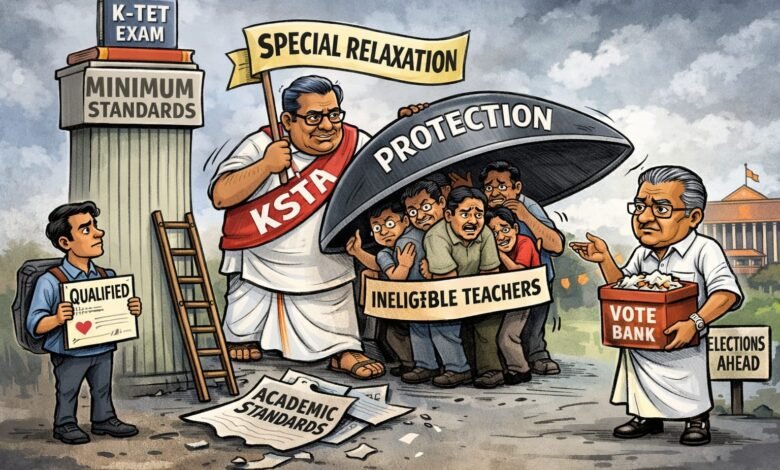
The Elastic Benchmark: Kerala’s Creative Interpretation of “Eligibility”
Kozhikode: Kerala’s education sector has long prided itself on high standards. But the recent special window under the Kerala Teacher Eligibility Test (K-TET) has left many wondering whether “minimum qualification” now comes with flexible margins.
Introduced in accordance with norms laid down by the National Council for Teacher Education (NCTE), the Teacher Eligibility Test was intended as a non-negotiable benchmark. A minimum. A baseline. A professional threshold.
Yet, in Kerala’s latest policy chapter, the threshold appears less like a line and more like a suggestion.

From Benchmark to Safety Net
Eligibility tests are meant to ensure competency before appointment. Critics argue that when repeated special opportunities become routine, the meaning of eligibility shifts from “qualified” to “eventually qualified.”
Thousands of candidates who cleared the benchmark through regular processes continue to wait for appointments. Their reward, it seems, is patience — while the system finds ways to ensure that the examination does not inconvenience those already inside.
Union Advocacy or Standard Dilution?
The role of the Kerala State Teachers Association (KSTA) has drawn pointed criticism from sections of the academic community. As a powerful teachers’ organisation, KSTA has reportedly backed measures aimed at protecting in-service teachers who have not cleared K-TET.
Unions exist to defend members. But critics argue that when a professional body supports policies that appear to dilute minimum qualification standards, it risks sending a troubling message about priorities.
“If a teachers’ organisation does not defend academic standards first, who will?” asked one senior educationist. “Protection without performance cannot be the foundation of quality education.”
Seniority as Strategy
Kerala’s promotion system places weight on seniority. Observers note that once eligibility is secured — by whatever route — time served may eventually outweigh initial qualification in promotional pathways, including Higher Secondary School Teacher (HSST) posts.
Younger teachers who cleared eligibility requirements at the outset may find themselves overtaken by a system that values tenure over timely competence.
Judicial Spirit and Administrative Reality
The Supreme Court of India has consistently underscored the importance of Teacher Eligibility Tests as safeguards aligned with national standards. While service matters involve complexity, the principle of minimum qualification has been central to judicial reasoning.
A Question of Leadership
Kerala’s education model has often been celebrated nationally. But the present debate raises an uncomfortable question: Should professional organisations push for raising standards — or for lowering the bar when it becomes difficult to cross?
In the end, the controversy is not merely about an examination. It is about institutional integrity. When eligibility becomes elastic and advocacy eclipses accountability, the real test may not be K-TET at all — but the system’s commitment to quality.