
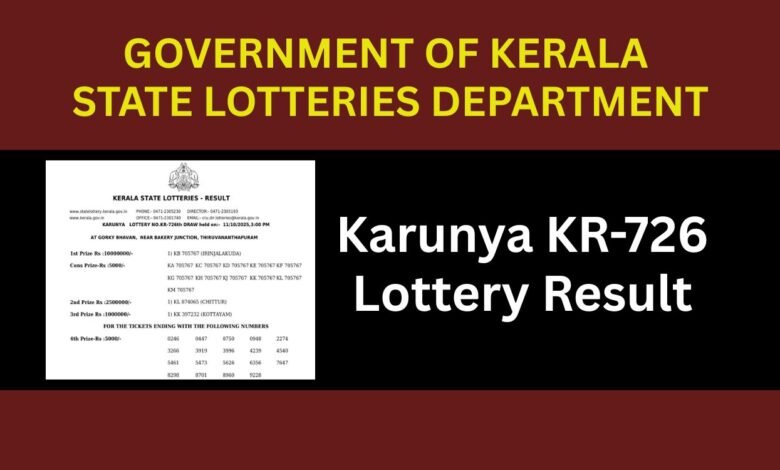
Thiruvananthapuram: The Kerala State Lotteries department has announced the results for the Karunya KR-726 lottery draw today, October 11, 2025. The official draw took place at Gorky Bhavan near Bakery Junction in Thiruvananthapuram at 3:00 PM.
A lucky ticket holder from Irinjalakuda has won the first prize of Rs 1 Crore with the ticket number KB 705767. The second prize of Rs 25 Lakhs was secured by ticket number KL 874065 sold in Chittur, while the third prize of Rs 10 Lakhs went to ticket number KK 397232 from Kottayam.
Participants can check the full list of winning numbers for all prize tiers below.

Official Karunya KR-726 Winning Numbers
1st Prize: Rs 1 Crore
- KB 705767
2nd Prize: Rs 25 Lakhs
- KL 874065
3rd Prize: Rs 10 Lakhs
- KK 397232
Consolation Prize: Rs 5,000
- KA 705767, KC 705767, KD 705767, KE 705767, KF 705767, KG 705767, KH 705767, KJ 705767, KK 705767, KL 705767, KM 705767
4th Prize: Rs 5,000
- 0246, 0447, 0750, 0948, 2274, 3266, 3919, 3996, 4239, 4540, 5461, 5473, 5626, 6356, 7647, 8298, 8701, 8960, 9228
5th Prize: Rs 2,000
- 2125, 3645, 4951, 8375, 8535, 9326
6th Prize: Rs 1,000
- 0328, 0603, 0893, 1602, 1751, 3030, 3089, 4054, 4187, 4407, 4663, 5317, 5631, 5659, 6201, 6323, 7700, 7769, 7770, 8025, 8426, 8718, 8782, 9119, 9529
7th Prize: Rs 500
- 0129, 0231, 0250, 0497, 0523, 0606, 1093, 1117, 1257, 1263, 1267, 1356, 1463, 1496, 1580, 1706, 1819, 1826, 1834, 1930, 2151, 2187, 2310, 2422, 2846, 3007, 3350, 3453, 3544, 3637, 4117, 4193, 4285, 4293, 4402, 4485, 4618, 4682, 4807, 4842, 4863, 5234, 5656, 5726, 6017, 6168, 6212, 6273, 6329, 6606, 6781, 6841, 6889, 6923, 7133, 7158, 7217, 7510, 7596, 7611, 7864, 7949, 7988, 8256, 8508, 8610, 8675, 8942, 9226, 9317, 9320, 9397, 9416, 9483, 9540, 9638
8th Prize: Rs 200
- 0005, 0107, 0121, 0223, 0236, 0351, 0402, 0440, 0462, 0478, 0622, 0926, 1303, 1650, 1752, 1781, 1799, 1818, 1883, 1924, 1926, 1954, 2098, 2141, 2661, 2714, 2730, 2823, 2960, 3041, 3072, 3082, 3096, 3362, 3573, 3680, 3738, 3769, 3909, 3947, 3952, 3998, 4000, 4051, 4446, 4552, 4556, 4633, 4712, 4743, 4985, 5161, 5163, 5532, 5715, 5755, 5884, 5915, 6005, 6173, 6420, 6536, 6632, 6649, 6721, 6812, 6867, 6900, 6943, 6984, 6995, 7009, 7130, 7147, 7220, 7351, 7726, 7851, 7900, 8241, 8432, 8584, 8884, 9116, 9167, 9211, 9404, 9749, 9825, 9901, 9970, 9975
9th Prize: Rs 100
- 0102, 0130, 0296, 0325, 0393, 0444, 0451, 0581, 0605, 0619, 0633, 0699, 0832, 0845, 1038, 1131, 1147, 1187, 1249, 1348, 1426, 1534, 1639, 1764, 1813, 1863, 1973, 1975, 2173, 2204, 2207, 2280, 2300, 2384, 2397, 2413, 2448, 2493, 2499, 2527, 2575, 2585, 2651, 2670, 2686, 2693, 2736, 2795, 2859, 2920, 2965, 3032, 3178, 3229, 3240, 3271, 3403, 3438, 3530, 3606, 3608, 3661, 3842, 3846, 3963, 4034, 4275, 4329, 4330, 4424, 4453, 4624, 4640, 4688, 4745, 4762, 4822, 4823, 4832, 4857, 4914, 5126, 5137, 5205, 5299, 5509, 5599, 5718, 5782, 5872, 5965, 5975, 5996, 6308, 6370, 6390, 6456, 6463, 6476, 6511, 6676, 6786, 6801, 6846, 7003, 7305, 7349, 7370, 7397, 7430, 7476, 7541, 7564, 7633, 7936, 8059, 8091, 8100, 8135, 8216, 8267, 8437, 8481, 8560, 8688, 8693, 8796, 8832, 8855, 8891, 8994, 9101, 9177, 9193, 9221, 9243, 9303, 9364, 9530, 9537, 9862, 9887, 9937, 9966
Prize winners are advised to verify their winning numbers with the results published in the Kerala Government Gazette. Winning tickets must be surrendered within 90 days of the draw date.
The next Karunya lottery draw will be held on October 18, 2025.