

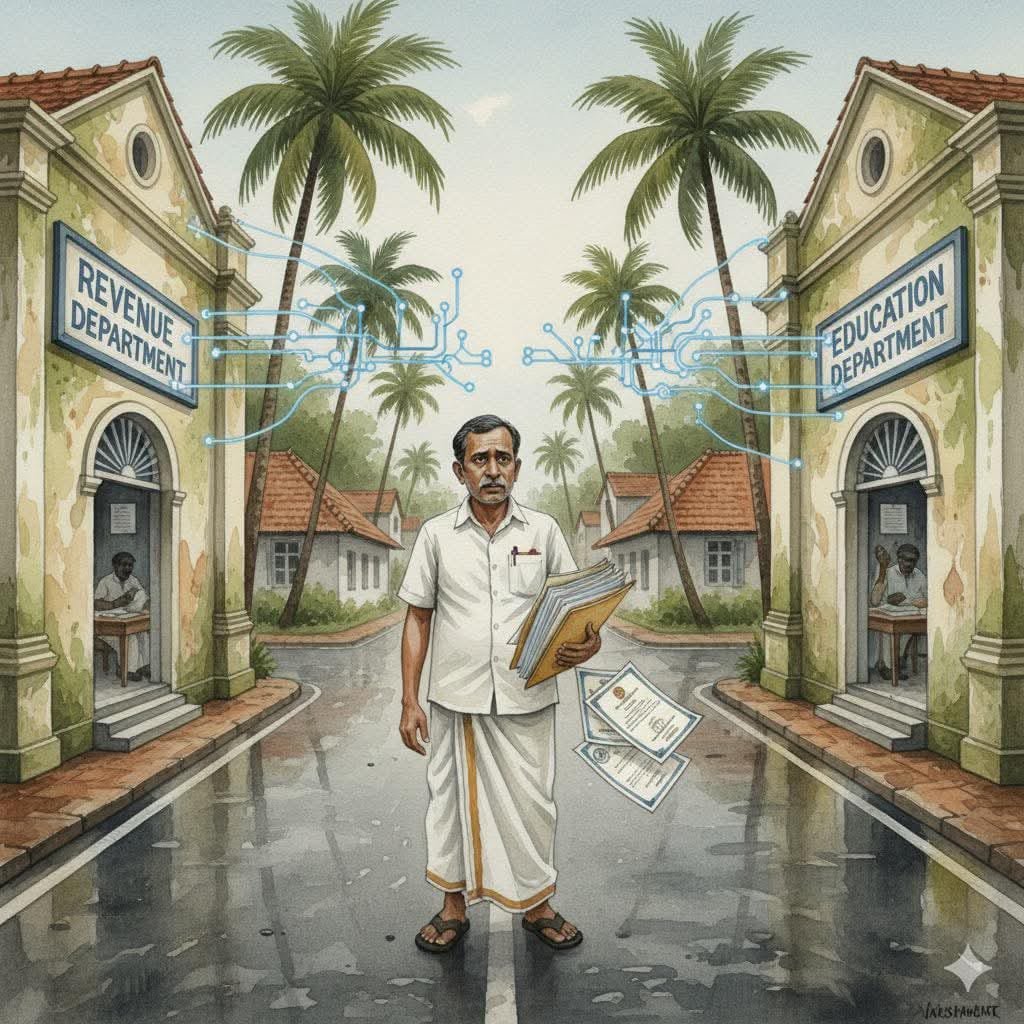

THIRUVANANTHAPURAM: A sharp critique of Kerala’s bureaucratic inefficiencies, despite its much-touted digital strides, has gone viral following a detailed Facebook post by IAS officer Prasanth. The post, titled “The ‘Courier Service’ between government offices,” exposes how citizens are burdened with transferring their own digital data between state departments, effectively acting as messengers for the government.
The officer highlights the daily struggle of thousands applying for essential certificates like income, caste, and ownership through the Akshaya/e-District portals. While the application process is digital, the underlying bureaucratic logic, he argues, remains stubbornly analog.
The ‘Purpose’ Trap and Inter-Departmental Mistrust
One of the central absurdities pointed out is the mandatory “Purpose” field during the application process. Applicants must state why they need a certificate, and this purpose is often printed in bold on the final document.
”Does my income or caste change based on the purpose for which I apply?” Prasanth questions. He asserts that this requirement is a reflection of an old, paper-file mindset that persists within the bureaucracy.
The core issue, according to the post, is a profound lack of trust between government departments. “Revenue issues an income certificate, which is then checked by the Education Department, or a Welfare Department, or a university,” he writes. Despite being part of the same administration, these entities behave like “neighbours at a wedding—distrustful of each other.” The simple solution—for one department to verify a digital document directly from another’s system—is ignored.
The Absurd 3-Step Process: Print, Scan, Upload
The most damning part of the critique focuses on the ridiculous workflow citizens are forced into:
- Applying for the certificate online.
- Printing the received digital certificate.
- Taking the printout to the next office (e.g., a college or welfare office).
- The receiving office then scans the printout and uploads it to their system!
”If digitisation has been implemented, why the three steps of print, scan, and upload?” the post asks, pointing out that this inefficiency is a burden of the government’s internal incompetence placed directly on the citizen.
Embracing the ‘Once-Only Principle’
Drawing parallels with international best practices, the IAS officer champions the ‘Once-Only Principle (OOP)’, which mandates that the government should never ask a citizen for data it already possesses.
Countries like Estonia, with its X-Road system, and Singapore, using SingPass, allow secure data flow between agencies, eliminating the need for citizens to carry physical printouts. Prasanth notes that India already has a robust technical foundation through Aadhaar, DigiLocker, and API systems, making the shift highly feasible. The main villain is the inter-departmental skepticism—”I won’t trust what you gave.”
Simple Reforms Suggested
To move beyond “digital red tape,” the post suggests four immediate, tangible reforms:
- Remove the ‘Purpose’ Field: Eliminate the ‘Purpose’ requirement from applications and certificate templates entirely. A certificate should be valid for any legal purpose within its tenure.
- Shift Verification Burden: Receiving departments must authenticate documents directly via QR codes, APIs, or DigiLocker, without involving the citizen, and fully abolish the print-and-scan process.
- Enable System Communication: Ensure seamless and secure data sharing between major systems like e-District and the upcoming K-Smart to prevent citizens from being shuttled between offices.
- Audit Based on Repetition: Evaluate field offices based on how often they require citizens to submit repeated information.
The officer concludes that the real administrative reform lies not just in digitising processes, but in reducing the discretionary power of officials. “Every unnecessary certification and every repeated certificate request opens the door to delays, frustration, and sometimes even corruption,” he writes.
The call to action is clear: for Kerala to lead in good governance, it must ensure that “data is what moves between offices, not people.”