

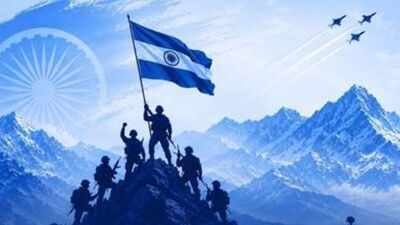

NEW DELHI — Twenty-seven years after Indian soldiers triumphantly raised the Tricolour on the icy heights of Kargil, the legacy of Operation Vijay continues to serve as the bedrock of India’s national security strategy, military modernization, and strategic doctrine.
Every year on July 26, Kargil Vijay Diwas is observed across the nation to honor the supreme sacrifice of 527 brave soldiers who laid down their lives and pay tribute to the thousands who fought against impossible odds in one of the world’s most perilous high-altitude battlefields.

The Unprovoked Aggression: Operation Badr
The roots of the 1999 conflict lay in covert Pakistani aggression during the winter of 1998–99. Taking advantage of the harsh winter conditions when high-altitude posts were traditionally vacated by both sides, troops from Pakistan’s Northern Light Infantry alongside paramilitary forces infiltrated across the Line of Control (LoC) under ‘Operation Badr’.
Disguised as local militants, the infiltrators occupied fortified peaks in Dras, Kaksar, Batalik, Mushkoh, and Kargil. Their primary objective was to sever National Highway 1D (Srinagar-Leh Highway), isolating Ladakh, cutting off supply lines to Siachen, and forcing India into negotiations over Kashmir. Local shepherds first alerted the Indian Army on May 3, 1999, triggering immediate reconnaissance that uncovered a massive tactical intrusion.
Operation Vijay and Tri-Service Coordination
In response, India launched Operation Vijay, deploying over 200,000 troops. Despite severe political restraint imposed by New Delhi—strictly forbidding Indian forces from crossing the LoC—the armed forces launched a coordinated tri-service campaign:
Indian Army: Spearheaded ground operations to contain, evict, and deny enemy positions.
Indian Air Force: Launched Operation Safed Sagar on May 26, executing precision airstrikes at altitudes above 20,000 feet.
Indian Navy: Executed strategic fleet deployments in the Arabian Sea to block potential maritime supply routes and exert pressure on Pakistan.
Crucial Battles That Turned the Tide
Faced with vertical cliff faces, sub-zero temperatures, and heavy artillery fire from entrenched enemy forces, Indian soldiers fought peak by peak:
Battle of Tololing (June 13, 1999): The capture of Point 4590 and Tololing by Indian troops broke Pakistan’s defensive line in the Dras sector, providing a vital psychological and tactical breakthrough.
Battle of Tiger Hill (July 4, 1999): In a daring multi-directional night assault, Indian soldiers scaled steep, sheer cliffs under intense enemy fire to reclaim Tiger Hill, securing control over the Srinagar-Leh Highway.
Point 4875, Batalik, & Mushkoh Valley: Continuous assault operations systematically dismantled enemy strongholds across all sectors.
By July 14, 1999, Prime Minister Atal Bihari Vajpayee announced that Operation Vijay had achieved its main objectives. On July 26, 1999, India formally declared complete success as the remaining enemy forces were completely evicted.
Heroes of the High Altitude
The war showcased extraordinary valor, leading to four Param Vir Chakra (PVC) awards:
Captain Vikram Batra (Posthumous) – Famous for his rallying call “Yeh Dil Maange More!”
Grenadier Yogendra Singh Yadav
Lieutenant Manoj Kumar Pandey (Posthumous)
Rifleman Sanjay Kumar
Additionally, 9 Maha Vir Chakras and 55 Vir Chakras were awarded to officers and jawans who demonstrated incredible bravery in high-altitude warfare.
Institutional Reforms and Military Transformation
The Kargil conflict exposed key gaps in joint service coordination, intelligence gathering, and high-altitude surveillance. The resulting Kargil Review Committee recommendations led to monumental structural changes in India’s defence setup:
Creation of Chief of Defence Staff (CDS): Established in 2020 to ensure jointness and seamless integration across the Army, Navy, and Air Force.
Department of Military Affairs (DMA): Formed to streamline procurement, operational planning, and tri-service synergy.
Defence Budget Growth: Defence allocations rose significantly from ₹2.53 lakh crore in 2013-14 to ₹7.85 lakh crore in the 2026-27 Budget, with capital outlay reaching ₹2.19 lakh crore.
Aatmanirbharta in Defence: Indigenous production hit a record ₹1.78 lakh crore in 2025-26, supported by Positive Indigenisation Lists covering over 15,700 items. Defence exports surged to ₹38,424 crore, reaching over 80 countries.
Modern Equipment Integration: From Rafale jet fighters, Apache & Chinook helicopters, and INS Vikrant to Pinaka Long Range Rockets, hypersonic systems, and AI-driven military infrastructure, India’s armed forces have evolved into a future-ready combat force.