

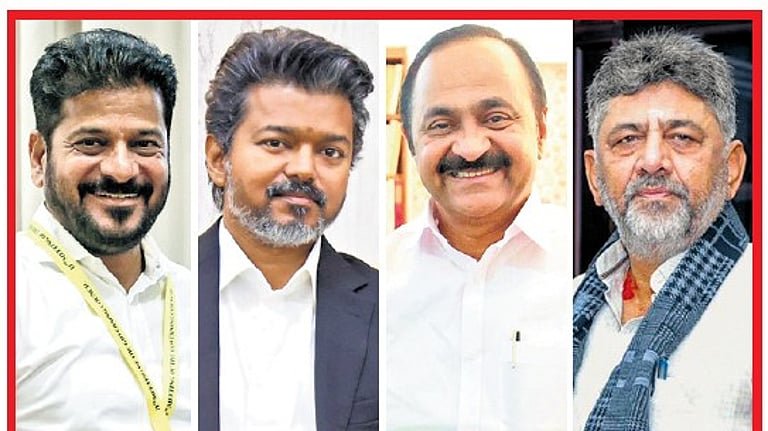

NEW DELHI / KERALA / TELANGANA / KARNATAKA / TAMIL NADU — In a dramatic shift that has altered the grammar of Indian federalism, four prominent Southern leaders have sent shockwaves through the national capital. Arriving at the recent Niti Aayog meeting not as separate regional petitioners or “supplicants,” but as a single, highly coordinated, and ideologically unified bloc, the leaders of Kerala, Telangana, Karnataka, and Tamil Nadu have firmly challenged the BJP-led central government.
This powerful “Southern Quartet” comprises:
V. D. Satheesan (Chief Minister of Kerala)
A. Revanth Reddy (Chief Minister of Telangana)
D. K. Shivakumar (Chief Minister of Karnataka)
Thiru. S. Joseph Vijay (Chief Minister of Tamil Nadu)
Together, they represent a colossal political and economic powerhouse. These four states account for 104 Lok Sabha seats (nearly one-fifth of the Lower House), generate close to 26% of India’s GDP, and contribute roughly 30% of the country’s direct tax revenues. None of these states are governed by the BJP, making this unified alliance a direct, high-stakes threat to the ruling party’s national dominance.
The Core Grievance: The Delimitation Threat
The primary catalyst behind this unprecedented southern solidarity is the upcoming parliamentary delimitation exercise scheduled after the next census.
The Southern states have historically behaved as model federal citizens—curbing population growth, investing heavily in education and healthcare, and building robust, export-oriented economies. However, under the current federal rules, parliamentary representation is based purely on raw population numbers. As a result, the South faces the penalty of losing Lok Sabha seats and political leverage to more populous Northern states, despite funding a massive chunk of the Union’s budget. The leaders argue that this rewards demographic expansion while actively penalizing governance and developmental success.
The Unique Strengths of the “Awesome Foursome”
Rather than engaging in mere political rhetoric, each leader brings a distinct, irreplaceable capability that transforms the alliance into a formidable machine:
V. D. Satheesan (The Intellectual & Moral Anchor): At 62, the lawyer-turned-six-time legislator who built his political career on principled, clean governance provides the bloc with its steady moral and philosophical calibration.
A. Revanth Reddy (The Sharp Articulator): The 56-year-old Telangana leader has given the delimitation crisis its sharpest national voice. He has proposed a groundbreaking hybrid formula—allocating half of the Lok Sabha seats based on population and the other half based on economic contribution—transforming a regional anxiety into a national constitutional question.
D. K. Shivakumar (The Organisational Engine): At 64, the master mobiliser and political strategist serves as the physical and tactical bridge to the peninsula. His unparalleled command of booth-level arithmetic ensures the alliance has the unglamorous, heavy-duty machinery required to sustain political power.
Joseph Vijay (The Disruptive Mass Magnet): The 51-year-old Tamil Nadu Chief Minister is the most disruptive force. Entering politics without dynastic backing, he converted an immense cultural phenomenon into a governing majority, controlling the South’s largest economy and its largest parliamentary contingent (39 Lok Sabha seats). His presence signals a shift in Tamil Nadu’s traditional isolation from active national frameworks.
The Strategic Shift
The BJP’s organizational footprint remains structurally constrained across Kerala, Telangana, and Tamil Nadu, with Karnataka being their only genuine battleground in the South. This asymmetry gives the Southern Quartet strategic breathing room that Northern opposition leaders rarely enjoy.
While regional coalitions historically risk fracturing under personal ambitions, the durable constitutional threat of delimitation offers a permanent point of alignment. If this “Awesome Foursome” maintains its discipline over the next decade, the old political binaries will dissolve. The era of “One Nation, One Party” faces its stiffest challenge yet, forcing the Centre to treat the South not as episodic dissenters, but as structural equals.