
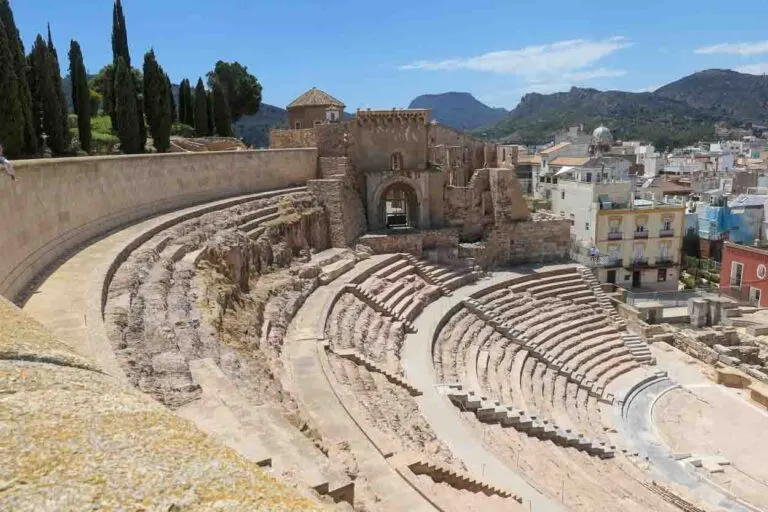

Cartagena, Spain: Rising from the historic heart of Cartagena in Spain’s Murcia region, the Roman Theatre of Cartagena offers visitors a remarkable glimpse into the grandeur of the ancient Roman city of Carthago Nova. Built during the Roman period, the theatre is today regarded as one of the most important archaeological monuments associated with Roman Cartagena.
A Monument from the Age of Augustus
The theatre was constructed in the late 1st century BC. Archaeological evidence and inscriptions indicate that its construction or inauguration took place approximately between 5 BC and 1 BC. It formed part of the major urban transformation of Carthago Nova during the Augustan period.
The location was carefully chosen on the slope of one of the city’s highest hills. This allowed the central part of the auditorium, or cavea, to be carved directly into the rock, while vaulted structures supported the lateral sections.

A Theatre for Thousands
The Roman Theatre had an estimated capacity of around 7,000 spectators, making it one of the major theatrical buildings of Roman Hispania. Its seating area was divided into three horizontal sections, reflecting the social hierarchy of Roman society. Different groups of citizens were assigned different areas of the auditorium.
The stage area extended for approximately 43.60 metres. In front of it was the semicircular orchestra, where specially reserved seats were provided for officials and other prominent members of society.
A Monument Hidden Beneath the Modern City
For centuries, the ancient theatre remained hidden beneath later layers of Cartagena’s urban development. Archaeological excavations eventually revealed the remains and opened a new chapter in the understanding of the city’s Roman past.
Adding to the site’s historical complexity is the medieval Santa María la Vieja church, which was built over part of the ancient theatre. The overlapping Roman and medieval remains make the archaeological site particularly significant.
Rafael Moneo’s Museum Project
The recovery and presentation of the Roman Theatre were incorporated into an ambitious museum project designed by renowned architect Rafael Moneo. The museum guides visitors through a carefully designed sequence of spaces before eventually leading them into the archaeological theatre itself.
The museum displays archaeological discoveries from the excavations and provides historical context about the monument and the ancient city. Its design effectively turns the Roman Theatre into the climax of the visitor experience.
More Than an Archaeological Site
The Roman Theatre Museum is not simply a place to view ancient ruins. It offers visitors an opportunity to understand the political, social and cultural life of ancient Carthago Nova through archaeological remains, exhibitions, interactive resources and guided visits. The museum also offers audio guides in several languages, including English.A standard museum visit takes approximately one hour, while guided tours are also available.
History Comes Alive at Night
The theatre continues to play a role in Cartagena’s cultural life. During the summer, the city organizes themed tours, family activities, theatrical experiences and special nighttime visits. The 2026 summer programme includes opportunities to explore the monument under moonlight and experience theatrical interpretations of Roman history.
Visitor Information
The Roman Theatre Museum is located at Plaza del Ayuntamiento in Cartagena. During the summer season, from May 1 to September 30, it generally opens from 10:00 AM to 8:00 PM from Tuesday to Saturday, while Sunday hours are 10:00 AM to 2:00 PM. The standard admission price is currently listed as €7.
More than two millennia after its construction, Cartagena’s Roman Theatre remains a powerful reminder of the scale and sophistication of Roman urban life. Its surviving stone seating, stage and architectural remains provide a direct connection to the ancient world, while the modern museum ensures that the story of Carthago Nova continues to reach new generations.