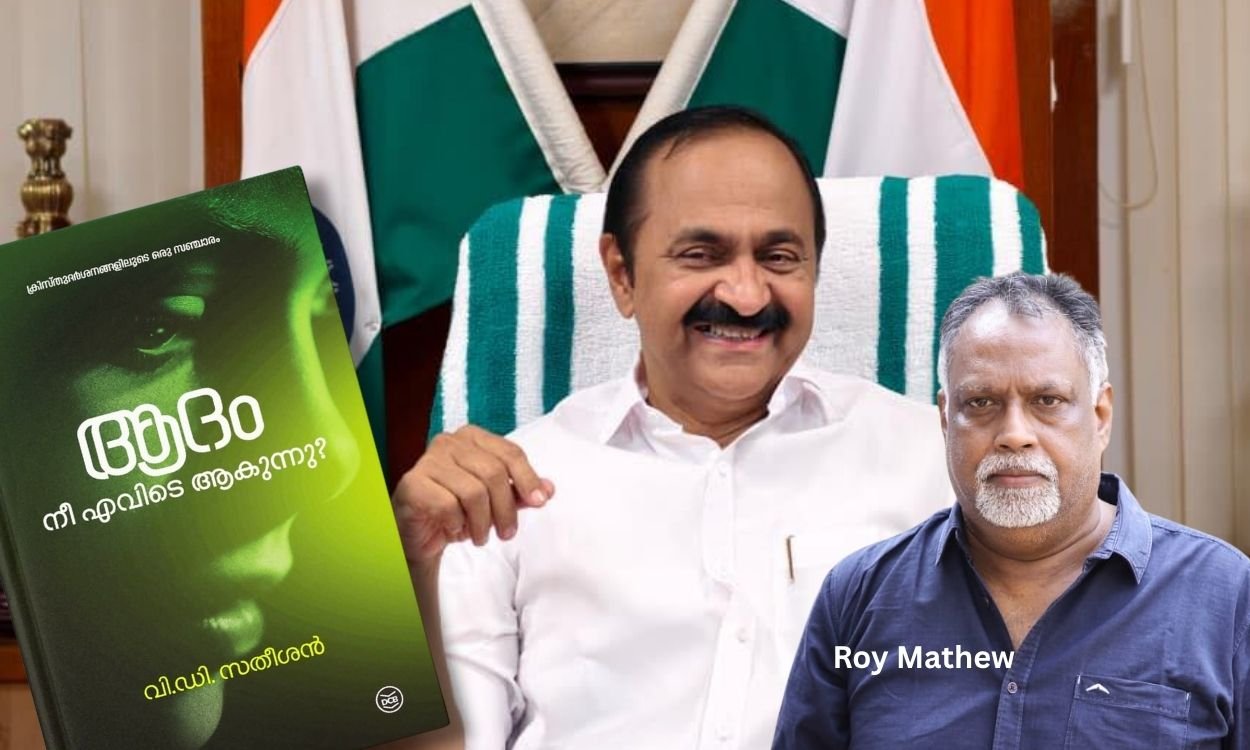


THIRUVANANTHAPURAM: Veteran journalist and political commentator A. J. Philip has shared a deeply insightful and reflective commentary on Facebook regarding the newly published book ‘Adam Nee Evide Aakunnu?’ (Adam, Where Are You?), authored by senior political leader V. D. Satheesan. Published by DC Books and meticulously edited by Roy Mathew, the volume compiles 32 profound speeches delivered by Satheesan across various Christian conventions and ecclesiastical gatherings, starting with his historic address at the Kumbanad Convention of the Indian Pentecostal Church of God on January 19, 2023.
The Spoken Word and the Art of Spontaneity
A. J. Philip opens his commentary with an illuminating anecdote shared by former Kerala Chief Secretary V. P. Joy regarding the late writer Omchery N.N. Pillai’s award-winning autobiography, Aakasmikam. Joy had noted that the book’s exceptional readability stemmed from it being dictated rather than written. Philip uses this to draw a broader parallel about language, noting that writing often invites structural ornamentation and vanity. Dictation, however, retains the “warmth of breath” and a rare spontaneity.

He recalls witnessing a similar effortless eloquence in the legendary O.V. Vijayan—who, when physically incapacitated by illness, dictated an entire short story to journalist Roy Mathew in one seamless flow without requiring a single edit—and in Swami Ranganathananda, whose unscripted English speeches flowed effortlessly like a calm river. According to Philip, V. D. Satheesan’s speeches possess this exact same rare, unvarnished, and conversational power where thought and language merge seamlessly.
A Politician’s Deep Communion with Scripture
While politicians routinely quote scriptures for short-term rhetorical or electoral gains, Philip observes that Satheesan’s engagement with the Bible is of a completely different, deeply spiritual order. It is an intimate, lifelong companionship. Philip references a recollection by Manoj Menon (Mathrubhumi), an alumnus of Sacred Heart College, Thevara, who noted that during inter-collegiate elocution competitions, other contestants only competed for the second prize, as the first was always guaranteed for Satheesan.
“Satheesan speaks not as a politician paying ceremonial tribute but as a believer reflecting on vocation and service.” — A. J. Philip
The veteran journalist points out that Satheesan’s daily routine includes reading at least one chapter of the Bible, finding sustenance in it during personal and political crises. Remarkably, Satheesan does not limit himself to the comforting narratives of the New Testament; he navigates the complex prophetic traditions, the Exodus, and the accounts of Moses in the Old Testament with phenomenal ease.
Prayer as a Relationship, Not a Bargain
Analyzing the title discourse taken from Genesis—where God seeks out a hiding humanity asking, “Adam, where are you?”—Philip highlights Satheesan’s beautiful theological definition of prayer. In the book, prayer is described not as a transactional negotiation with the divine for rewards, but as an intimate process of discerning what God desires one to become. Philip beautifully anchors this theme by bringing in the history of Joseph M. Scriven’s 1855 hymn What a Friend We Have in Jesus, and Major Daniel Webster Whittle’s There Shall Be Showers of Blessing, illustrating a shared human yearning for inner renewal.
Rescuing St. Thomas and Honoring Church Legends
The review lauds Satheesan for rescuing Thomas the Apostle from the simplistic caricature of “Doubting Thomas,” portraying him instead as a disciple of courageous, questioning, yet ultimately surrendering faith.
Furthermore, the book contains historically significant portraits of towering church leaders:
Abraham Mar Thoma: Evoking his immense courage in inviting social reformer C.V. Kunhiraman to the Maramon Convention, which catalysed social reforms like the Temple Entry Proclamation, and his brave resistance against the autocratic Diwan C. P. Ramaswami Iyer.
Juhanon Mar Thoma: Highlighting his legendary resilience against the Emergency, his direct letters to Indira Gandhi against censorship, and his sheer magnanimity in offering lifts to his legal critic K.N. Daniel.
Modern Icons: Heartfelt tributes to the unparalleled empathy of Oommen Chandy, the educational vision of Orthodox Bishop Thomas Mar Dionysius, and the humanitarian legacy of Stan Swamy.
Concluding Thoughts: A Universal Framework of Faith
A. J. Philip concludes that the true success of Adam Nee Evide Aakunnu? lies in its structural rejection of denominational triumphalism or sectarian frameworks. Echoing the anxieties of missionary E. Stanley Jones, who lamented that Christians often promote their denominations more than Christ himself, Satheesan’s speeches intentionally steer the reader back to Christ-centred living. It stands out as an exceptional literary and spiritual work that bridges ancient scripture with modern existential anxieties, making it a rewarding read for believers and secular readers alike.